
How to Paraphrase Effectively and Avoid Plagiarism

The Submit button shouldn't feel like a gamble. The solution isn't just swapping words for synonyms; it is mastering the academic craft of paraphrasing. By rewriting information in your own voice, you demonstrate a deeper understanding of your research and protect your academic integrity.
At The Page Doctor, we help students create polished, original assignments. Whether you are tackling an undergraduate essay or a complex dissertation, learning to paraphrase effectively is the most important skill you can develop to improve your marks and lower your similarity scores.
Quoting, Summarising, and Paraphrasing: What is the Difference?
To write a high-quality paper, you must know when to use different types of evidence. Many students rely too heavily on one, which can lead to a disjointed argument or a high plagiarism flag. Understanding these distinctions is the first step in effective academic writing.
1. Quoting
Quoting involves using the author’s exact words inside quotation marks. In UK academic writing, quotes should be used sparingly. Use them only when the original phrasing is so unique that changing it would diminish its impact or when you are analysing the specific language used by a source.
Example of a Quote:
According to Smith (2023, p. 12), "The socio-economic impact of the pandemic on urban centres was nothing short of catastrophic."
2. Summarising
Summarising is used when you need to condense a large amount of information into a few concise points. It provides a broad overview and is significantly shorter than the original source.
Example of a Summary:
Smith (2023) argues that the pandemic caused significant and lasting damage to the economies and social structures of major cities.
3. Paraphrasing
Paraphrasing is taking a specific idea or piece of data and rewriting it entirely in your own words. It should be roughly the same length as the original but must sound like your own academic voice.
Example of a Paraphrase:
Smith (2023) suggests that the financial and social stability of metropolitan areas was severely compromised by the global health crisis.
The "Read, Hide, Write" Technique: A Practical Exercise
The biggest mistake students make is trying to paraphrase while looking directly at the source. This leads to patchwriting, where you accidentally mirror the original sentence structure. Turnitin is specifically designed to catch these matching patterns.
To avoid this, use the Read, Hide, Write method:
Read: Carefully read the passage until you fully grasp the core argument.
Hide: Close the book or minimise the PDF. Remove the original text from your sight entirely.
Write: Explain the idea out loud or write it down as if you were explaining it to a classmate. Use your own natural vocabulary.
Check: Re-open the source. Ensure you haven't used the same unique phrasing but have kept the technical meaning accurate.
Changing Structure, Not Just Synonyms
Using a thesaurus to exchange individual words is a common trap. Modern plagiarism software identifies the "DNA" of a sentence. To lower your similarity score, you must transform the sentence construction.
Switch Active and Passive Voice
This is one of the most effective ways to change the flow of a sentence without losing the technical meaning.
Original (Active): "The researcher conducted the experiment over three weeks."
Paraphrased (Passive): "A three-week period was required for the completion of the experiment."
Change the Parts of Speech
Try turning verbs into nouns or adjectives into adverbs.
Original: "The economy grew rapidly."
Paraphrased: "There was a rapid growth in the economy."
Reorder the Argument
If the original sentence starts with the "cause" and ends with the "effect," try reversing them.
Original: "Due to the rise in global temperatures, polar ice caps are melting at an accelerated rate."
Paraphrased: "Polar ice caps are experiencing accelerated melting, a direct consequence of increasing global temperatures."
Citation Basics: When to Cite (and When You Don't Need to)
A common myth is that if you paraphrase, you don't need a citation. This is false. Even if every single word is your own, the idea still belongs to the original author.
Always Cite When:
You use a specific theory, model, or framework.
You mention data, statistics, or specific research findings.
You paraphrase an author’s unique opinion or argument.
You Don’t Need to Cite When:
You are stating Common Knowledge (e.g., "The United Kingdom left the European Union in 2020").
You are presenting your own original primary research.
You are offering your own concluding thoughts or synthesis.
In the UK academic system, the penalty for under-citing is far harsher than the penalty for over-citing. When in doubt, include the reference.
Common Paraphrasing Pitfalls to Avoid
The Synonym Trap: Replacing words with synonyms that don't quite fit the context.
Missing the Context: Paraphrasing a sentence but losing the nuance of the author's argument.
Over-Paraphrasing: Trying to rewrite technical terms (like "Photosynthesis") that cannot be changed.
How The Page Doctor Can Help You Get to the End Point
Mastering the art of paraphrasing is a high-stakes challenge because the way you attribute ideas determines whether your work is perceived as original scholarship or a breach of academic integrity. Success is about restructuring concepts, not just swapping words. You already have the evidence, but our professional guides provide the essential roadmap to move beyond surface-level changes and master the "translate-and-cite" technique. By using our curated resources, you can eliminate the guesswork of navigating complex citation styles and the common pitfalls of patchwriting, allowing you to submit with certainty and take the pressure off. Our services ensure your writing isn't just unique, but a polished, professional instrument that honors your sources while moving your academic career forward with confidence.
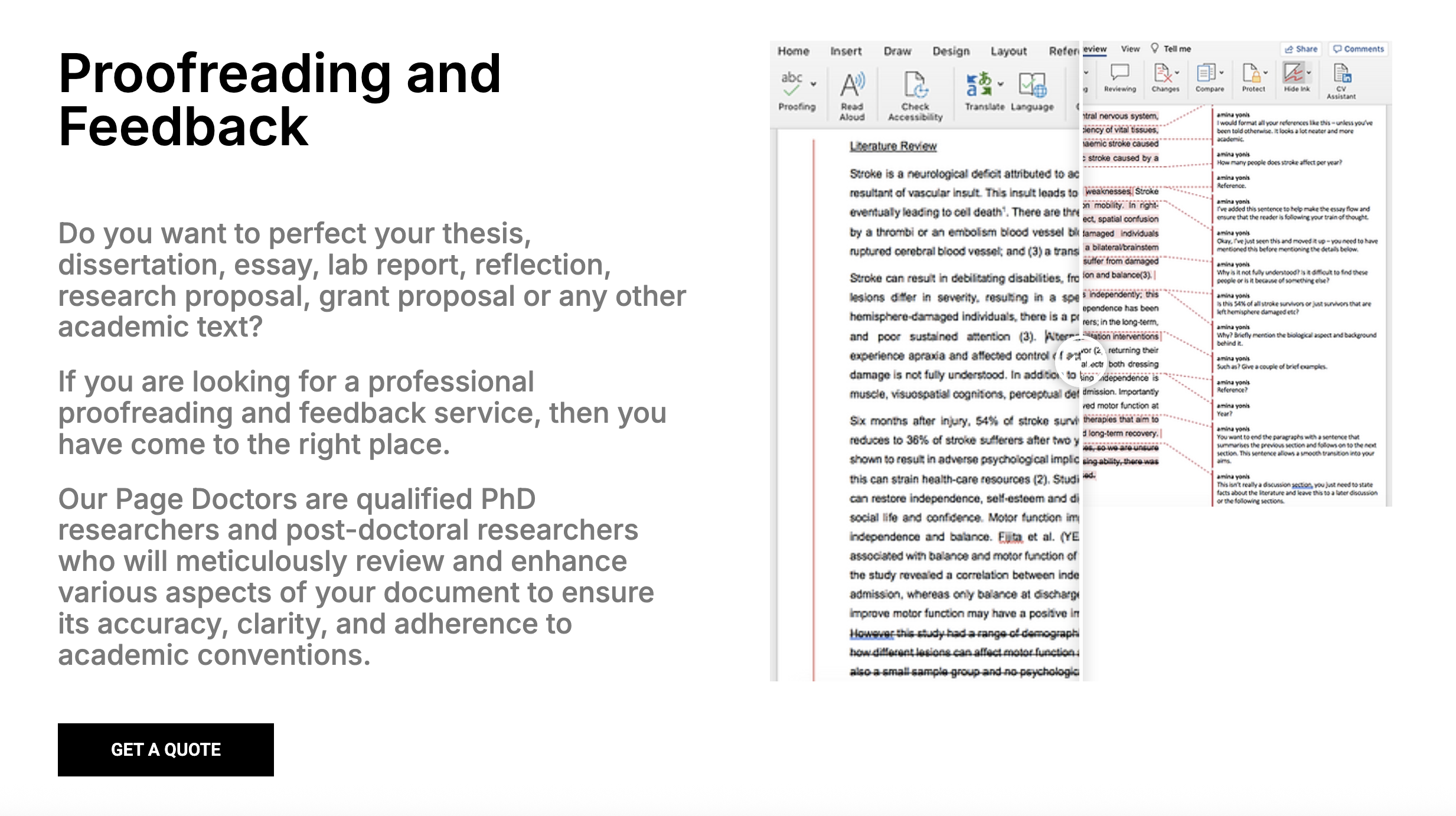
Once you have finished the heavy lifting and completed your draft, do not leave your academic reputation to chance. Book our professional editing service; simply send it to us and we will refine it for you. Our team will meticulously check your paraphrasing accuracy, citation consistency, and logical flow to ensure your research is presented in the best possible light for your supervisors!
Follow us for more updates!
At The Page Doctor, we help you overcome these hurdles through:
1-1 Consultation with Dr Amina: Work with Dr Amina to identify exactly where your writing is falling short. We provide the feedback your lecturers often don't have time to give.
Proofreading & Feedback Services: Our team is composed of qualified PhD researchers and post-doctorate researchers who will meticulously review and enhance various aspects of your documents to ensure its accuracy, clarity and adherence to academic conventions.
Free Resources: Check out our founder’s YouTube channel for tutorials on everything from dissertation planning to mastering Harvard and APA referencing.
Expert-designed templates: Guides to support you through all stages of your academic journey.
