
20 Words to Avoid in Academic Writing

Academic writing is a formal style of expression used in universities and scholarly publications. It is not just about using big words to sound clever; rather, it is a precise, evidence-based method of communication designed to convey complex ideas with clarity, objectivity, and logical consistency.
At The Page Doctor, we see thousands of drafts every year. We know that the difference between a 2:1 and a First often comes down to word choice. To help you polish your prose, we have compiled the ultimate list of 20 taboo words and phrases you should excise from your drafts immediately.
The "Subjective" List: Removing the "I" from Information
One of the most common pitfalls for students is injecting too much personality into their work. In the UK academic tradition, objectivity is king. Your findings should speak for themselves. If your evidence is strong, you don't need to tell the reader that you believe it; the evidence will prove it.
1. "I think"
This is perhaps the biggest culprit in undergraduate essays. Saying "I think the results show..." weakens your stance. It frames your conclusion as a personal opinion rather than a scholarly observation.
Examples:
"The analysis indicates that..." (Best for when you've just broken down a concept).
"It can be inferred that..." (Use this when drawing a logical conclusion from specific facts).
"The findings demonstrate..." (Strong and definitive for the results section).
"This suggests a correlation between..." (Great for showing how two things might be linked).
"Current trends point toward..." (Useful for discussing future implications or ongoing phenomena).
2. "I feel"
Academic writing is about analysis, not emotion. "Feeling" that a policy is ineffective is irrelevant in a formal paper. You must demonstrate why it is ineffective through data.
Examples:
"Examination of the text reveals..." (Perfect for literary or qualitative analysis).
"There is a discernible shift in..." (Objective way to describe a change you've noticed).
"The implications of this policy are..." (Directly addresses the effect rather than your reaction to it).
"Critically, it appears that..." (Signals that you are making an evaluative judgment).
"Practical applications show that..." (Moves the focus to real-world evidence).
3. "In my opinion"
If you are writing the essay, the reader already knows the arguments presented are yours. Adding "in my opinion" is redundant and diminishes the authority of your claims.
Examples:
"Significantly, [X] represents..." (Places importance on the subject itself).
"It is widely argued within the literature that..." (Places your "opinion" within a broader academic conversation).
"Taking [X] into account, it is clear that..." (Shows your conclusion is a result of specific factors).
"A compelling case can be made for..." (A classic academic way to propose a strong viewpoint).
"Primary sources confirm that..." (Backs your "opinion" with the weight of original evidence).
4. "I believe"
Similar to "think" and "feel," this brings an element of faith or personal conviction into a space that should be reserved for logic.
Examples:
"The theoretical framework suggests..." (Ties your "belief" to established academic theories).
"Established data reinforces the idea that..." (Shows that your stance isn't new; it's supported).
"It is consistent with [Author/Study] that..." (Aligns your conviction with other experts).
"Empirical evidence validates the claim that..." (The ultimate "fix" for scientific or social science writing).
"The results provide a basis for..." (Frame your belief as a foundation for further study).
The "Absolute" List: The Danger of Generalisations
In academia, it is very rare for something to be 100% certain. Science and humanities are based on the idea of "falsifiability." When you use absolute language, you leave yourself open to easy criticism. If you say something "always" happens, a marker only needs to find one single instance where it didn't prove you wrong.
5. Always
The world is full of variables. Using "always" makes your writing seem naive and ignores the nuances of your subject matter.
The Fix: Use "frequently," "typically," or "in many instances."
6. Never
Just like "always," this is too restrictive. Scholarly caution (often called "hedging") is a sign of a sophisticated writer.
The Fix: Use "rarely," "seldom," or "is unlikely to."
7. Perfect
No study, theory, or solution is perfect. Claiming perfection suggests you haven't critically analysed the limitations of your topic.
The Fix: Use "optimal," "highly effective," or "suitable."
8. Proof/Proves
In many disciplines (especially the social sciences), we don't "prove" things; we find evidence that supports a hypothesis. "Proof" is a very high bar that is rarely met.
The Fix: Use "indicates," "suggests," "demonstrates," or "supports."
The "Vague" List: Precision is Key
Vague language is the enemy of a high mark. Your tutor wants to see that you have a command over the specific terminology of your field. If you find yourself using "filler" words, it is a sign that you need to dig deeper into your vocabulary.
9. Good / Bad
These are moral judgements, not analytical ones. What makes a result "good"? Is it significant? Is it ethical? Is it cost-effective?
The Fix: Use "advantageous," "robust," "detrimental," or "flawed."
10. Thing
This is the least academic word in English. Everything has a name. If you are talking about a "thing," you aren't being specific enough.
The Fix: Use "concept," "phenomenon," "variable," or "issue."
11. Stuff
Like "thing," this is far too casual and belongs in a text message, not a dissertation.
The Fix: Use "material," "data," or "components."
12. A lot / Lots
These are imprecise measurements. How many is "a lot"? In a formal paper, you should provide specific figures or more formal quantifiers.
The Fix: Use "a significant number," "the majority," or "substantial."
13. Big / Small
These are relative terms that lack academic weight.
The Fix: Use "extensive," "sizeable," "minor," or "negligible."
14. Get / Got
These are colloquial. There is almost always a more precise verb describing how something was obtained.
The Fix: Use "obtain," "acquire," "develop," or "secure."
Technical and Style "Taboos"
15. Etcetera (etc.)
Ending a list with "etc." suggests that you have run out of examples or are too lazy to list the relevant ones.
The Fix: End the list with a final example or introduce the list with "including..."
16. Really / Very
These are known as "intensifiers." In most cases, they add no actual value to the sentence. If something is "really important," it is simply "crucial."
The Fix: Use "considerably," "notably," or a more powerful adjective.
17. Use of Contractions (Don't, Can't, Won't)
In UK academic writing, you must always use the full form of the word. Contractions are considered too informal for essays.
The Fix: "Do not," "cannot," "will not."
18. Rhetorical Questions
"Why did the economy crash?" This is a great way to start a conversation, but in an essay, you should be providing answers, not asking the reader questions.
The Fix: Rephrase as a statement: "This section examines the factors that led to the economic crash."
19. "Obviously" or "Clearly"
If something were truly obvious, you wouldn't need to write an essay about it. Using these words can come across as condescending to the reader or as a way to gloss over a point you can't actually prove.
The Fix: "It can be observed that..." or "The evidence suggests..."
20. Cliches (e.g., "At the end of the day")
Academic writing should be original and direct. Cliches are "thought-terminating clichés" that add bulk without substance.
The Fix: "Ultimately," or "In conclusion."
How The Page Doctor Can Help You Succeed
Mastering academic tone is a high-stakes challenge because the language you choose determines whether your research is perceived as rigorous scholarship or amateur observation. Success is about precision, not complexity; you already have the insights, but our professional guides provide the essential roadmap to strip away informal "taboo" words and replace them with authoritative, objective alternatives. By using our curated resources, you can eliminate the guesswork of navigating academic conventions and linguistic pitfalls, allowing you to submit with certainty and take the pressure off. Our services ensure your writing isn't just clear, but a polished, professional instrument that commands respect and moves your academic career forward with confidence.
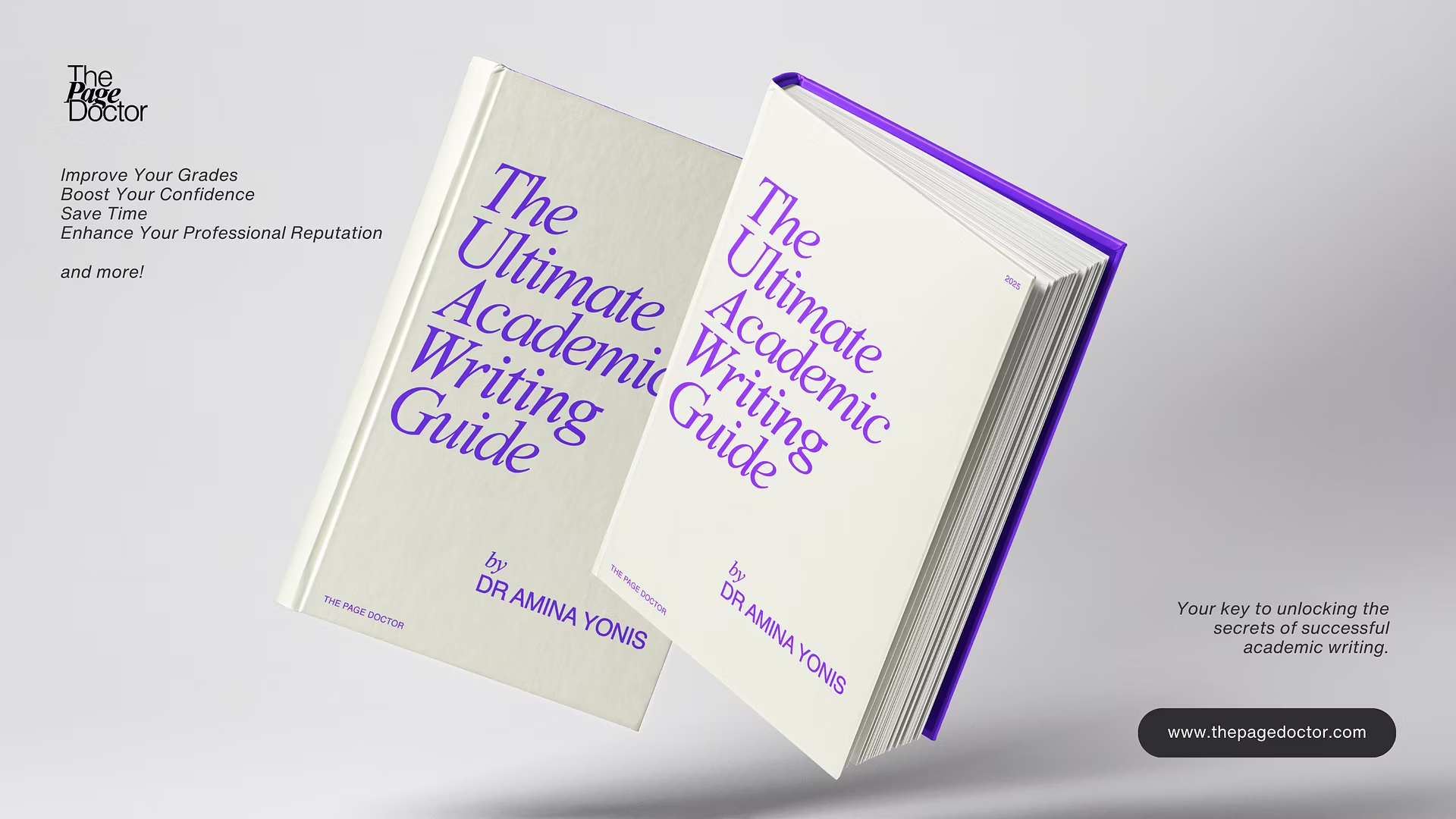
Our Ultimate Academic Writing Guide is a comprehensive resource designed to transform your writing from a source of stress into a powerful professional asset. By offering step-by-step mastery of everything from captivating introductions and persuasive arguments to complex literature reviews and precise citations, this guide helps you secure higher grades and build a formidable research reputation. More than just a manual, it provides the efficient strategies and expert tips needed to overcome writer’s block, streamline your workflow, and produce polished, high-impact papers that stand out in any academic field.
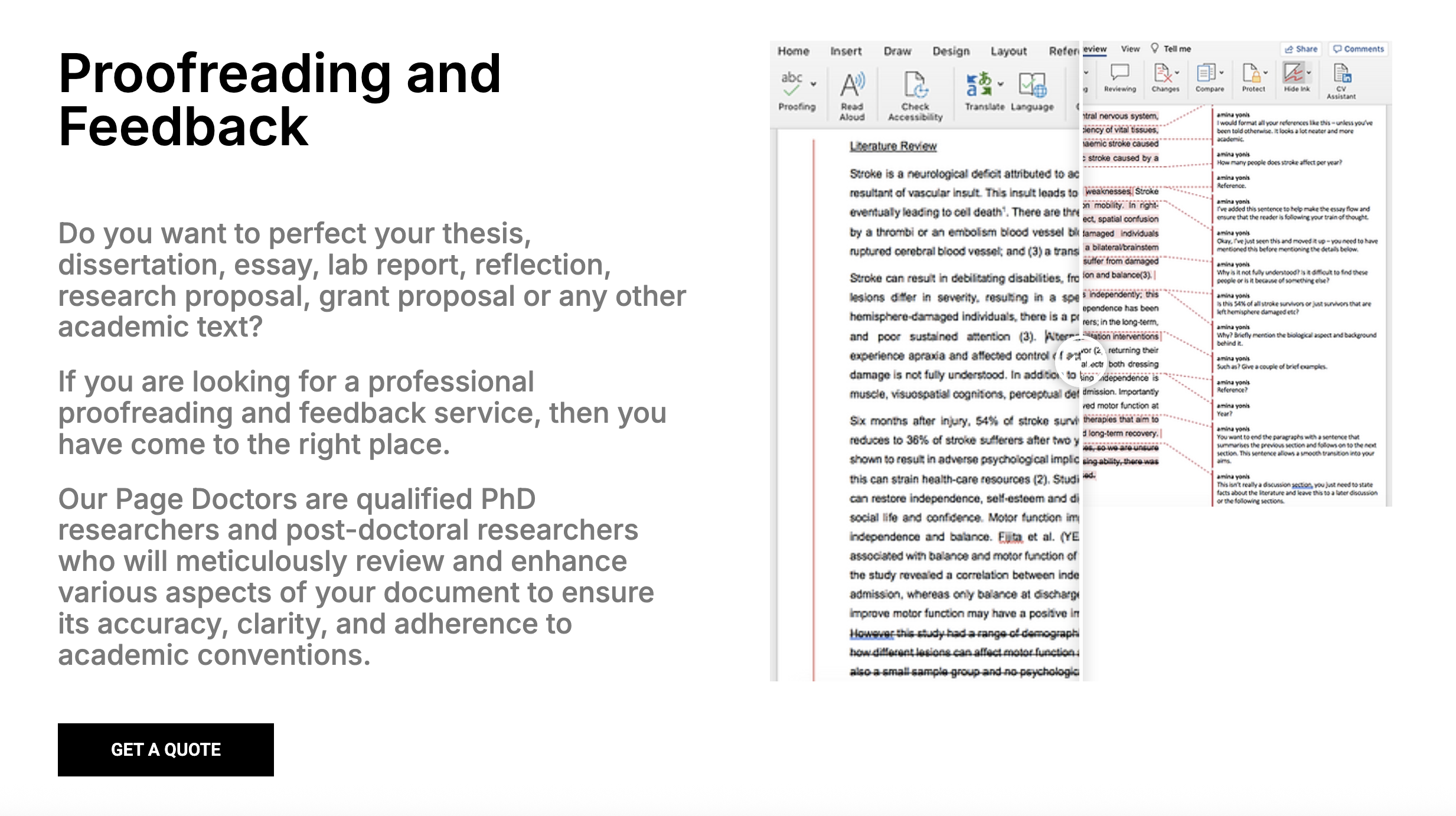
Once you have finished the heavy lifting and completed your draft, do not leave your approval to chance. Book our professional editing service; simply send it to us and we will refine it for you. Our team will check your flow, tone, and logical consistency to ensure your project is presented in the best possible light for your supervisors!
Follow us for more updates!
At The Page Doctor, we help you overcome these hurdles through:
1-1 Consultation with Dr Amina: Work with Dr Amina to identify exactly where your writing is falling short. We provide the feedback your lecturers often don't have time to give.
Proofreading & Feedback Services: Our team is composed of qualified PhD researchers and post-doctorate researchers who will meticulously review and enhance various aspects of your documents to ensure its accuracy, clarity and adherence to academic conventions.
Free Resources: Check out our founder’s YouTube channel for tutorials on everything from dissertation planning to mastering Harvard and APA referencing.
Expert-designed templates: Guides to support you through all stages of your academic journey.
