
How to Write a Literature Review (Without Getting Lost)

A literature review is a critical survey of existing research that serves as the backbone of your entire project. When you are faced with hundreds of potential sources, it is common to treat this section as a book report that lacks a clear, analytical purpose.
At The Page Doctor, we see people every day who are drowning in PDFs and struggling to move past the annotated bibliography stage. The literature review isn't a summary of everything you’ve read. It is a critical argument.
In this guide, we’ll show you how to write an excellent literature review.
The Purpose: It’s an Argument
Before accessing research databases, it is essential to define the objective of the literature review. A common misconception is that the review serves as a proof of exhaustive reading; in practice, examiners prioritize the ability to synthesize and critically evaluate information.
The literature review fulfills these six core academic functions:
Establishment of Theoretical Framework: It identifies and explores the prevailing theories, models, and conceptual frameworks that underpin the research area to provide a baseline for the current investigation.
Synthesis of Existing Knowledge: It moves beyond a chronological summary by integrating disparate findings, identifying common themes, and articulating the current "state of the art" within a specific discipline.
Identification of Research Gaps: It systematically maps the boundaries of existing knowledge to highlight contradictions, under-researched populations, or methodological limitations that justify the need for further study.
Critical Evaluation of Methodology: It assesses the validity and reliability of previous studies, critiquing research designs and data collection methods to ensure the current work avoids past pitfalls.
Contextualization of the Research Question: It demonstrates how the proposed study fits into the broader scholarly conversation, ensuring the research is relevant and builds upon established academic foundations.
Demonstration of Scholarly Authority: It serves as evidence of the researcher's command over the field, proving they have the requisite depth of knowledge to engage in high-level academic discourse.
Understanding these objectives is the first step in moving from passive reading to active scholarship. Once the purpose is clear, the focus shifts to the systematic identification and selection of sources that will form the backbone of your critical argument.
Step 1: Search & Select (The Art of Strategic Filtering)
The biggest time-sink in research is reading papers that don’t actually matter for your specific project. To avoid this, you need a rigorous filtering system. If you try to read 100 papers from start to finish, you will burn out before you've even written a paragraph.
Keywords and Boolean Logic
Don’t just search for your broad topic. Use Boolean operators to narrow the field:
AND: Connects two terms (e.g., "Literacy AND Socio-economic status").
OR: Finds papers with either term (e.g., "Qualitative OR Ethnographic").
NOT: Excludes terms (e.g., "Education NOT Primary").
The Abstract and Conclusion Rule
Never read a paper in full until it has passed the "Abstract Test." Read the abstract to see if the aims align with yours, then skip straight to the conclusion. If the findings don't directly relate to your research questions or provide a necessary piece of background context, discard it. You do not have time for "interesting but irrelevant" reading.
The Snowball Method
When you find a "gold nugget" paper, a study that perfectly aligns with your topic, look at its reference list. Who are they citing? Those authors are likely the "heavyweights" in your field. Conversely, use "Cited By" features to see who has referenced that study since it was published. This allows you to trace the evolution of an idea from its inception to the present day.
Step 2: Thematic Analysis (Group by Ideas, Not Authors)
This is the most crucial step for achieving a high mark. If your paragraphs start with "Smith (2019) says..." followed by "Jones (2020) says...", you aren't writing a review; you’re writing an annotated bibliography.
Instead, you must group your research by themes. A theme is a recurring idea, a point of contention, or a specific lens.
How to categorise your reading:
Methodological Themes: Grouping papers that used similar ways of gathering data. For example, you might have a section on "Quantitative Trends" followed by "Qualitative Perspectives."
Theoretical Themes: Grouping papers based on the specific lenses they use. For instance, you might group studies that use Marxist theory versus those using Functionalism.
Chronological Themes: Only use this if the evolution of the idea over time is the most important factor.
By grouping by theme, you can compare and contrast.
Example: "While the majority of scholars suggest X, a growing body of recent evidence (Smith, 2022; Taylor, 2023) suggests Y."
This shows you are in control of the literature, rather than being buried by it.
Step 3: The "Funnel" Technique for Structure
Structure is where most people get "lost." To keep your reader (and yourself) on track, use the Funnel Technique. This ensures your writing remains focused and leads logically to your own research.
The Wide Top (The Context)
Start with the broad context of your field. Why does this topic matter globally or socially? You are establishing the "big picture" here before zooming in.The Middle (The Themes)
Narrow down to the specific sub-themes you identified in Step 2. This is most of your review. Discuss the major debates, the conflicting findings, and the established theories.The Narrow Neck (The Specifics)
Focus on the studies that are most closely related to your specific research question. This is where you scrutinise the work that is doing exactly what you are doing.The Point (The Gap)
This leads directly into your "Gap". The reason your study must exist. The entire funnel has been designed to point to the fact that there is a hole in the knowledge that only you can fill.
Step 4: Identifying and "Selling" the Gap
The "gap" isn't necessarily something no one has ever thought of before; it’s simply a space where more research is needed to provide clarity. Your job is to "sell" this gap so the reader understands why your research is worth their time.
Common "Gaps" to look for:
The Population Gap: A theory has been tested on one group, but not another.
The Geographic Gap: Plenty of research exists in one part of the world, but very little addresses your specific region.
The Methodological Gap: Everyone has used large-scale surveys, but no one has done in-depth interviews.
The Contradiction Gap: Study A says one thing, Study B says another. Your study will help settle the score or explain why they differ.
Step 5: The "Write-Up" Phase and Criticality
When you finally sit down to write, remember that academic tone is key. There is a heavy emphasis on "hedging", avoiding over-confident claims.
Instead of saying: "This proves that participants were unhappy," try: "The evidence suggests a correlation between low engagement and workload, which may indicate..."
Also, pay close attention to your signposting. Words like "however," "consequently," "moreover," and "simultaneously" act as signposts for your reader, telling them how the next sentence relates to the one before it. This creates "flow" and prevents your review from feeling like a collection of disjointed facts.
Synthesising vs. Summarising
To synthesise is to combine different ideas to create a new, broader understanding. If you find yourself writing one paragraph per paper, you are summarising. To fix this, try to ensure every paragraph contains at least two or three different citations. This forces you to talk about the topic rather than the author.
How The Page Doctor Can Help You Cross the Finish Line
Writing a literature review is a high-stakes task because it determines whether or not you can move forward with your degree, secure a supervisor, or obtain vital funding. Success is smarter, not harder; you already have the knowledge, but our professional templates provide the essential framework to transform overwhelming information into a compelling, high-impact pitch. By using our curated resources, you can eliminate the guesswork of structuring your synthesis and identifying research gaps, allowing you to get approved faster and take the pressure off. Our services ensure your literature review isn't just a summary, but a strategic asset that proves your project’s worth and moves your academic career forward with confidence.
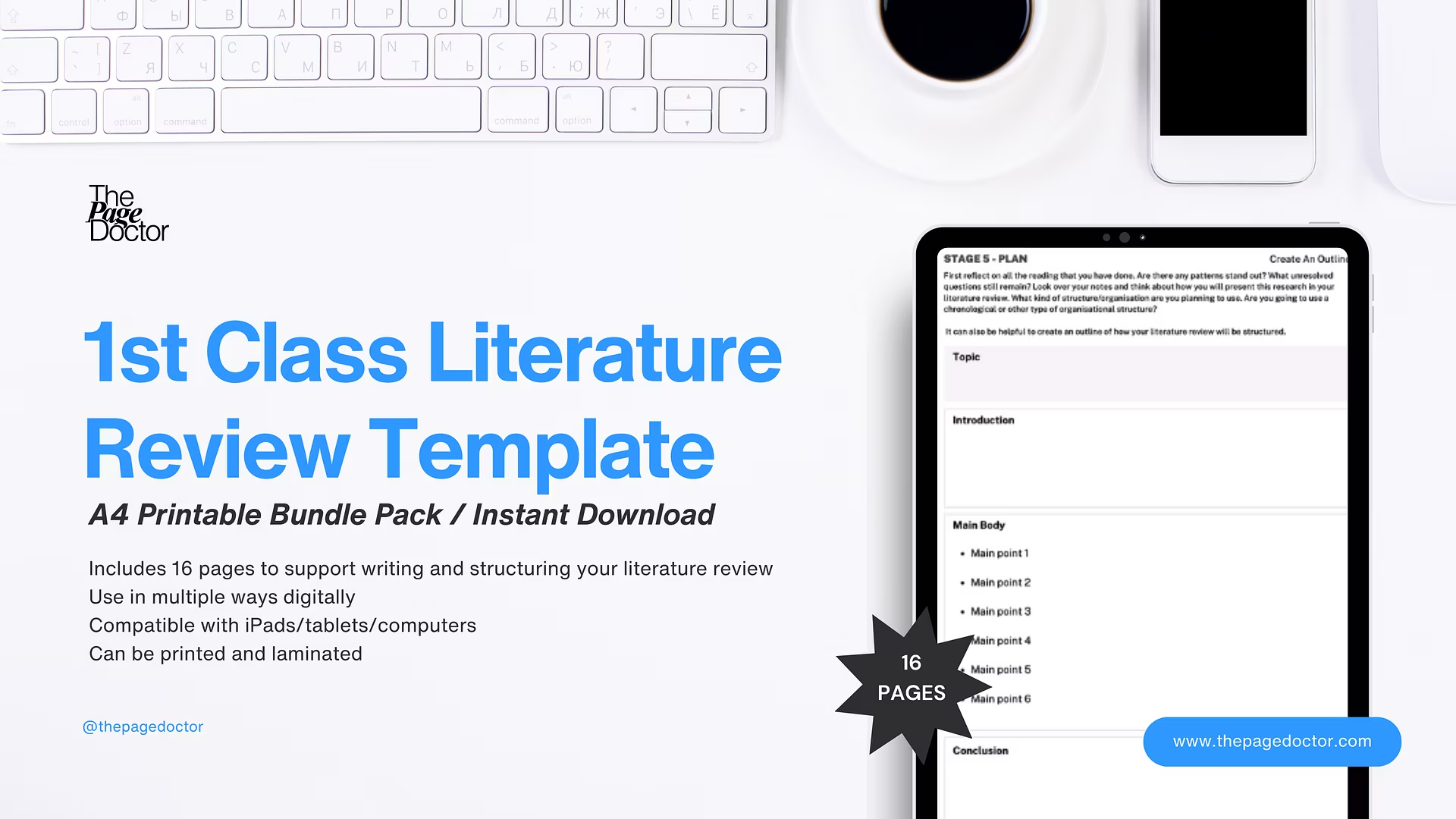
Our comprehensive literature review bundle provides a structured, six-stage framework designed to help you achieve first-class results without the stress of information overload. Rather than a simple summary, this professional template guides you through a critical, analytical synthesis of existing research, offering 16 pages of strategic resources including task checklists, brainstorm maps, and precise paragraph layouts. Whether you choose to use it digitally on a tablet, as a reusable laminated planner, or in a traditional printed binder, these tools empower you to organise complex arguments into a compelling pitch, ensuring you get your research approved faster while taking the guesswork out of the process.
Once you have finished the heavy lifting and completed your draft, do not leave your approval to chance. Book our professional editing service; simply send it to us and we will refine it for you. Our team will check your flow, tone, and logical consistency to ensure your project is presented in the best possible light for your supervisors! If you’d prefer more hands-on guidance before you hit submit, you can also book a 1-1 with a consultant to help plan your lit review and ensure your strategy is airtight.
Follow us for more updates!
At The Page Doctor, we help you overcome these hurdles through:
1-1 Consultation with Dr Amina: Work with Dr Amina to identify exactly where your writing is falling short. We provide the feedback your lecturers often don't have time to give.
Proofreading & Feedback Services: Our team is composed of qualified PhD researchers and post-doctorate researchers who will meticulously review and enhance various aspects of your documents to ensure its accuracy, clarity and adherence to academic conventions.
Free Resources: Check out our founder’s YouTube channel for tutorials on everything from dissertation planning to mastering Harvard and APA referencing.
Expert-designed templates: Guides to support you through all stages of your academic journey.
