
How to Write a Research Proposal

A research proposal is a 2,000 to 4,000-word blueprint that serves as the gateway to your final project. When you are eager to get started, it is a common mistake to view this as a mere administrative hurdle rather than the foundation that determines whether your study is actually feasible.
At The Page Doctor, we often see students treating the proposal as a simple to-do list or a vague outline of their interests. In reality, a research proposal is a sales pitch. Its job is to convince a supervisor or an admissions committee that your topic is intellectually significant, feasible, and most importantly, worth their time and resources.
A first-class proposal proves that you have identified a problem and that you possess the methodological toolkit to solve it. In this guide, we will break down the essential components of a winning proposal, from the initial title to the preliminary methodology, ensuring your project gets the green light it deserves.
Section 1: The Title and Abstract: First Impressions Matter
Your title is the first thing a reviewer will read, and it must strike a delicate balance. It must be catchy enough to spark interest but descriptive enough to tell the reader exactly what the study is about. A common mistake is being too broad, for example, "A Study of Education Policy."
A first-class title is specific and often includes your variables, context, or theoretical lens. An example would be: "The Impact of Inclusive Education Policy on Primary School Attainment in East London: A Qualitative Case Study."
The abstract, usually around 200 to 300 words, is a condensed version of your entire pitch. It should summarise the research problem, your main aim, your proposed methodology, and the expected contribution of the work. Think of it as an elevator pitch for research. If the reviewer is not convinced by the end of the abstract, they are unlikely to be impressed by the rest of the document.
Section 2: Background and Significance: Setting the Academic Scene
Once you have their attention, you need to provide context. The background section is not just a history lesson; it is a way to prove that your topic is relevant right now. Why does this matter in 2026? What are the current socio-economic, political, or scientific pressures that make this research timely?
You are essentially setting the stage. You need to demonstrate a high level of academic awareness by mentioning the broad themes currently dominating your field. This section should lead the reader logically towards the specific problem you want to address.
Section 3: Defining the Research Gap: The Vital Ingredient
This is the most critical part of any research proposal. To get approved, you must prove that your specific area has not been fully explored yet. If you are just repeating what five other scholars have already done, your proposal will likely be rejected.
A research gap is the missing piece of the academic puzzle. You can identify this gap by looking for:
Population Gaps: A theory has been tested in the US but not in a UK context.
Methodological Gaps: A topic has been studied through quantitative surveys but never through in-depth qualitative interviews.
Temporal Gaps: The existing research is ten years old and no longer reflects the modern landscape or current technological shifts.
Proving the gap shows the marker that you have a deep command of the current literature and that you are prepared to make an original contribution to knowledge. It transforms your work from a student essay into a piece of professional research.
Section 4: Aims and Objectives: The What and the How
Many students use these terms interchangeably, but they are quite different. Getting this right is a hallmark of a first-class student and is essential for a high-quality PhD proposal or dissertation plan.
The Aim: This is the big picture. It is what you want to achieve by the end of your project. It is usually a broad statement, such as: "To investigate the relationship between social media use and sleep quality in teenagers."
The Objectives: These are the specific, measurable steps you will take to achieve that aim. Think of them as milestones in your journey. For example: "1. To review existing literature on adolescent sleep patterns. 2. Conduct semi-structured interviews with 20 participants. 3. To analyse the data using thematic analysis."
Your objectives should be SMART: Specific, Measurable, Achievable, Realistic, and Time-bound. If your objectives are too ambitious, the reviewer will flag your project as unfeasible, which is a common reason for proposals to be sent back for major revisions.
Section 5: Preliminary Methodology: Explaining the Process
At the proposal stage, you do not need to have every tiny detail worked out, but you must show that you have a viable plan for gathering and analysing data. Will you be using quantitative methods, such as large-scale surveys? Or qualitative methods like archival research or focus groups?
You must justify your choices. If you are choosing interviews, explain why that is better for your specific research question than a questionnaire would be. Mentioning potential ethical considerations or access issues also shows great academic maturity.
Phase 6: Mastering Critical Discussion in Your Plan
While the proposal is a plan for future work, you still need to demonstrate critical thinking. This means moving beyond description. Instead of saying "I will use this theory," explain why this theory is the most robust choice compared to others.
Critically evaluate the limitations of your proposed methodology. For instance, if you are conducting a small-scale case study, acknowledge that the results may not be generalisable, but explain why the depth of data collected is more valuable for your specific aims.
Why You Might Be Getting Stuck (and How We Help)
Writing a research proposal is a high-stakes task because it determines whether or not you can move forward with your degree, secure a supervisor, or obtain vital funding. Success is smarter, not harder. You already have the knowledge; you just need the framework to present it as a compelling, professional pitch. To help you get approved faster and take the guesswork out of the process, we have curated the perfect resources to take the pressure off.
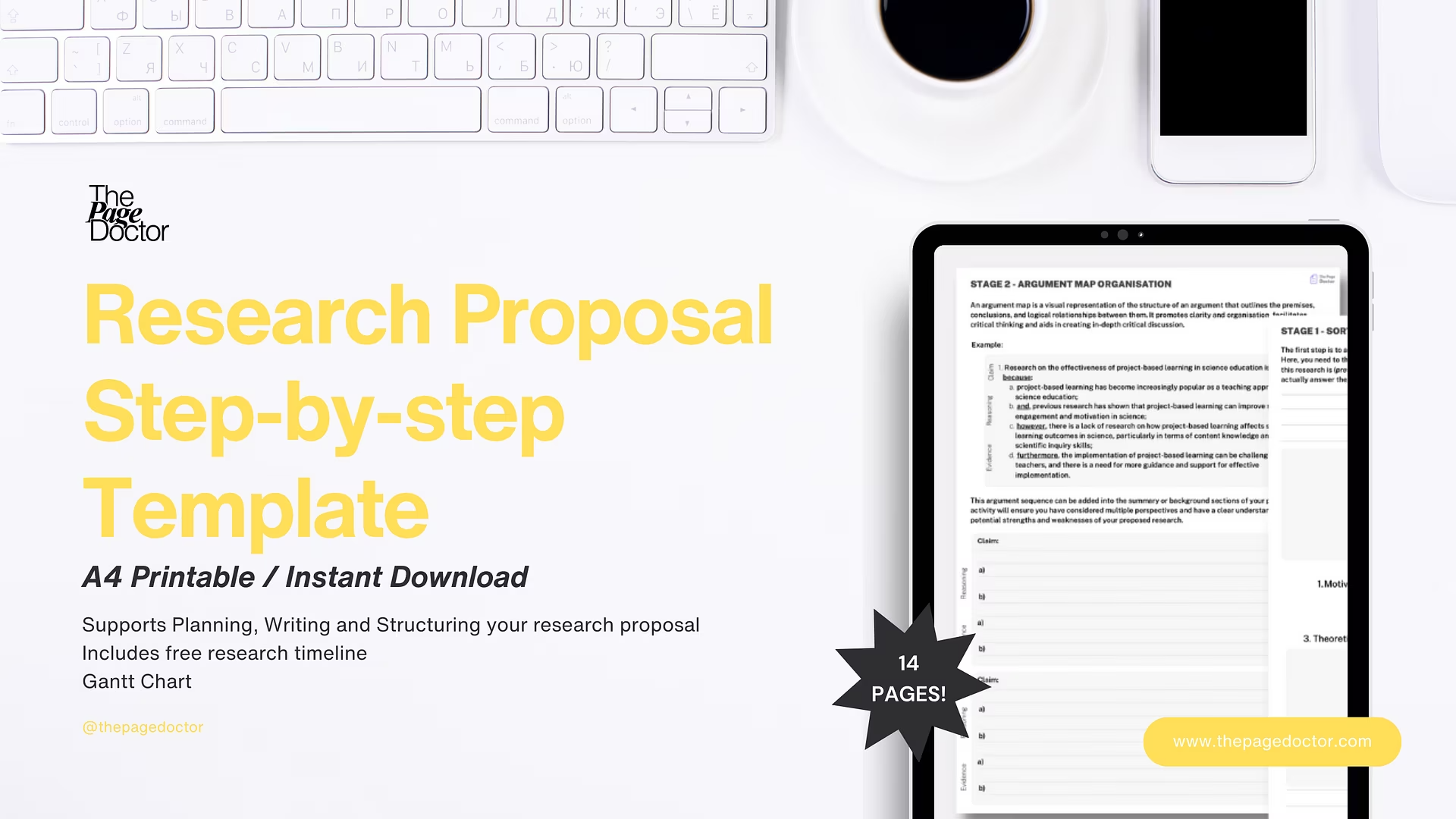
No one likes staring at a blank document, which is why we created our comprehensive Research Proposal Bundle. This 14-page PDF guide teaches you how to write a proposal from start to finish, ensuring you understand exactly what is required to get accepted into a research programme. The bundle includes a three-stage breakdown of the entire process, an argument map with prompts to sharpen your logic, and a structured layout for every paragraph of your literature review. You will also receive a research plan Gantt Chart in MS Word format to prove your project is feasible, along with brainstorming and mind-map tools to help with the idealisation of your ideas. This toolkit is designed to save you hours on formatting and layout, ensuring your pitch is professional, persuasive, and ready for submission.
Once you have finished the heavy lifting and completed your draft, do not leave your approval to chance. Book our professional editing service; simply send it to us and we will refine it for you. Our team will check your flow, tone, and logical consistency to ensure your project is presented in the best possible light for your supervisors!
Follow us for more updates!
At The Page Doctor, we help you overcome these hurdles through:
1-1 Consultation with Dr Amina: Work with Dr Amina to identify exactly where your writing is falling short. We provide the feedback your lecturers often don't have time to give.
Proofreading & Feedback Services: Our team is composed of qualified PhD researchers and post-doctorate researchers who will meticulously review and enhance various aspects of your documents to ensure its accuracy, clarity and adherence to academic conventions.
Free Resources: Check out our founder’s YouTube channel for tutorials on everything from dissertation planning to mastering Harvard and APA referencing.
Expert-designed templates: Guides to support you through all stages of your academic journey.
