
How to Structure a Dissertation: A Chapter-by-Chapter Breakdown

A dissertation is a 10,000 to 20,000-word document that stands between you and your degree. When you are staring at a project of this scale, it is a common mistake to dive straight into the research or start writing random sections as they come to mind.
However, at The Page Doctor, we always tell our students that in the early stages, structure is actually more important than content. Without a solid framework, you are simply gathering a pile of bricks without a blueprint for the house. A well-structured dissertation guides the reader through your logical journey, making it easier for the marker to award you those high First-Class marks.
In this guide, we will break down the essential Hourglass model and provide a chapter-by-chapter roadmap to help you navigate this academic milestone with confidence. We will also look at how you can avoid the common pitfalls that lead to a stressful final month.
The Hourglass Model: Visualising Your Research Flow
Before we look at individual chapters, it is helpful to visualise the overall flow of a dissertation using the Hourglass Model. This model represents how your focus should shift throughout the project, moving from the general to the specific and back again.
The Top (Broad): You begin with a broad introduction to the field, narrowing down to your specific research question or "gap."
The Middle (Specific): Your methodology and results sections are highly specific, focussing purely on your unique data and the nitty-gritty of your experiment or analysis.
The Bottom (Broad): In your discussion and conclusion, you widen the lens again, explaining how your specific findings contribute back to the broader academic field and what the real-world implications might be.
By keeping this visual in mind, you can ensure your dissertation feels cohesive rather than like a collection of unrelated essays. This flow is essential for achieving a high classification because it demonstrates your ability to contextualise your own work within the wider academic landscape.
Chapter 1: The Introduction - Establishing the Research Gap
The introduction is your chance to set the scene and, crucially, justify why your research needs to exist. A common pitfall is being too vague or assuming the reader already knows why the topic is important. A first-class introduction should accomplish three main things:
Provide Context: Give the reader enough background to understand the importance of the topic in the current climate.
Identify the Research Gap: What is missing from current academic knowledge? Your dissertation should be the "plug" for that gap.
State Research Questions and Aims: Clearly list what you intend to find out. If your aims are blurry, your whole dissertation will be too.
Chapter 2: The Literature Review - Synthesis, Not Summary
Many students treat the literature review like a book report, listing what Author A said, then what Author B said. This is descriptive writing and will rarely get you above a 2:2. To achieve a First-Class mark, you must synthesise the literature.
Synthesis means grouping authors by theme, identifying where they agree or disagree, and critically evaluating their methods. You are not just summarising what exists; you are building an argument that leads directly to your own research. You should aim to highlight contradictions or limitations in previous studies, which justifies why your specific study is necessary.
Chapter 3: The Methodology - Justifying Your Choices
The methodology is your thesis instruction manual. If another researcher read this chapter, they should be able to replicate your study exactly. However, do not just list what you did. You must justify why you chose a specific approach.
Why qualitative over quantitative?
Why did you choose that specific sample size?
Why that particular theoretical framework?
A strong methodology defends your choices against potential criticism. This is often where students lose marks by being too brief. You need to show the marker that you understand the philosophical underpinnings of your research methods.
Chapter 4: Results and Discussion - What You Found and Why It Matters
In some disciplines, these are separate chapters; in others, they are combined. Regardless of the format, this is the heart of your work where your original contribution shines.
In the Results section, present your data clearly using text, tables, or graphs. Avoid the temptation to include every single piece of data you found; focus on what is relevant to your research questions.
In the Discussion section, you interpret the data. This is where you go back to the hourglass bottom. How do your results compare to the literature you discussed in Chapter 2? Do they support or contradict existing theories? This is the place for deep critical discussion and for demonstrating your expertise. If your results were unexpected, do not hide them. Explaining why they might have occurred is a sign of high-level academic maturity.
Chapter 5: The Conclusion - Summarising the Journey
Your conclusion should tie all the threads together without introducing any new evidence. Briefly restate your main findings, acknowledge any limitations of your study, and suggest areas for future research. Leave the reader with a clear understanding of your contribution to the field.
Final Thoughts on Dissertation Success
Success in your dissertation is about consistency and clarity. Start with the structure, understand the requirements of each chapter, and give yourself plenty of time for the editing phase. You have the knowledge and the passion for your subject; now use the right tools to show the markers exactly what you are capable of.
Need a Head Start? How We Can Help You
A dissertation is often the most significant project you will ever undertake, and it is completely normal to feel stuck at the halfway mark. Many students find that they have plenty of research but no idea how to thread it together into a cohesive argument. Success in your final year is about working smarter, not harder. You already have the subject knowledge; you just need the structural framework to present it to a First-Class standard. To help you overcome the "dissertation block" and get started right now, we have curated the perfect resources to take the guesswork out of the planning phase.
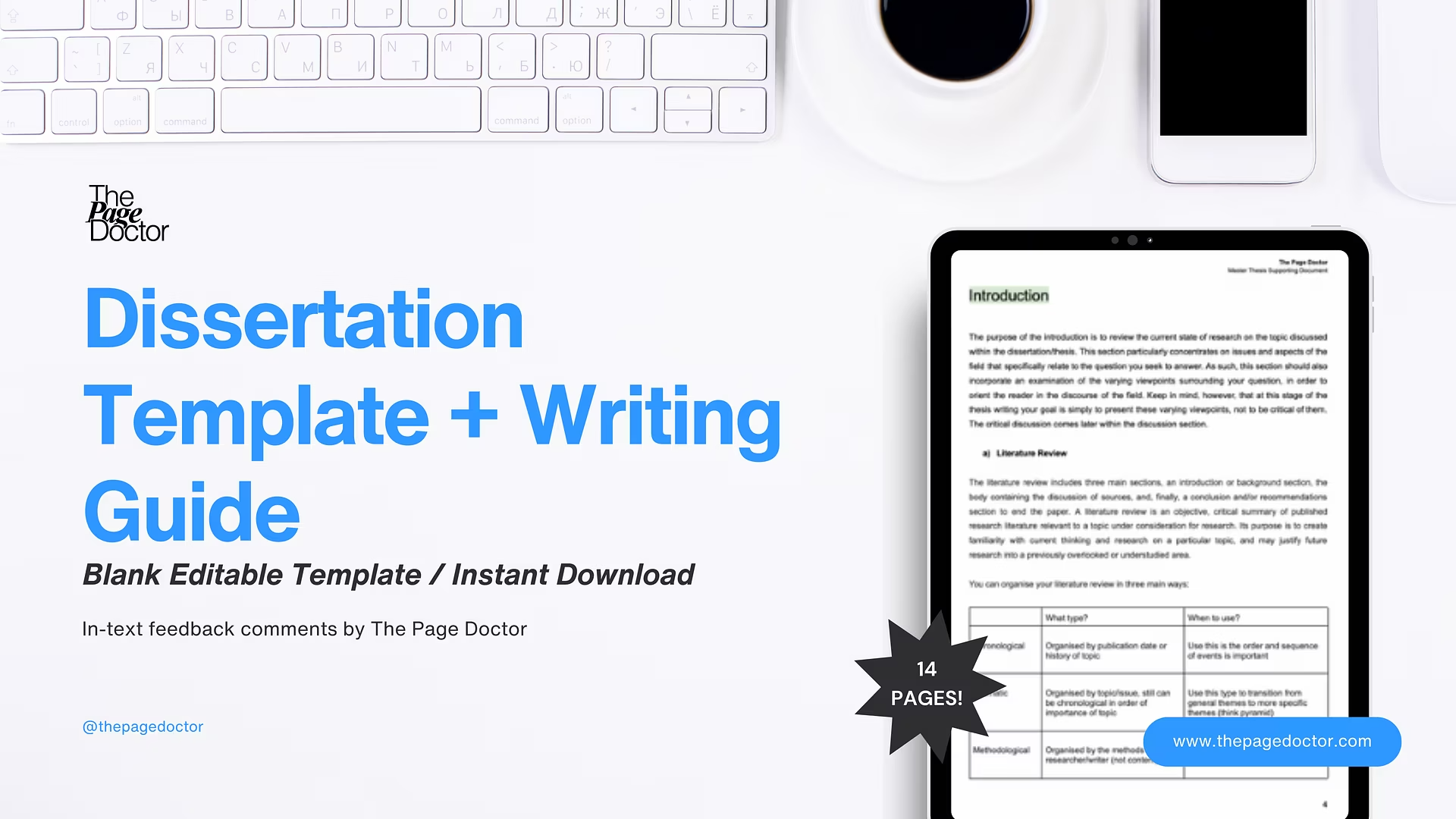
No one likes staring at a blank document, which is why we created the ultimate Dissertation Template Bundle. This editable MS Word template features hyperlinked chapters and built-in feedback notes to remind you exactly what to include and which tense to use as you write. Based on a decade of experience in academic marking, the bundle also includes a 14-page eBook guide that breaks down the full sentence structure for every chapter, along with a task checklist and a bank of academic vocabulary. This bundle is designed to save you hours on formatting and layout, ensuring your structure is rock solid.
Once you have finished the heavy lifting and completed your draft, do not leave your final classification to chance. Book our professional editing service; simply send it to us and we will refine it for you. We will check your flow, tone, and formatting, giving you the peace of mind that your work is ready for submission!
Follow us for more updates!
At The Page Doctor, we help you overcome these hurdles through:
1-1 Consultation with Dr Amina: Work with Dr Amina to identify exactly where your writing is falling short. We provide the feedback your lecturers often don't have time to give.
Proofreading & Feedback Services: Our team is composed of qualified PhD researchers and post-doctorate researchers who will meticulously review and enhance various aspects of your documents to ensure its accuracy, clarity and adherence to academic conventions.
Free Resources: Check out our founder’s YouTube channel for tutorials on everything from dissertation planning to mastering Harvard and APA referencing.
Expert-designed templates: Guides to support you through all stages of your academic journey.
