
The Ultimate Guide to Writing a First-Class Essay (Fast)

We have all been there: the deadline is looming, the caffeine is wearing thin, and the pressure to achieve that elusive First-Class mark feels overwhelming. Whether you are studying at a top-tier university or a local college, the expectations for academic writing are high, and the time available is often short.
But here is a secret that top-performing students know: writing a first-class essay is not about being a "natural" writer. It is about following a systematic, repeatable process. At The Page Doctor, we specialise in stripping away the academic mystery and giving you practical, actionable strategies to boost your marks.
In this guide, we will walk you through the exact phases required to produce high-quality academic work at speed, ensuring you meet every marking criterion without the last-minute panic.
Phase 1: Decoding the Prompt
The most common reason students lose marks is not a lack of knowledge; it is failing to answer the actual question. Before you type a single word of your introduction, you must dismantle the essay prompt. University lecturers use specific command words that dictate the entire structure of your response. If you misinterpret these, you are building your essay on shaky foundations.
Understanding Command Words
In higher education, certain verbs carry heavy weight. Here are the big ones you need to master:
Analyse: This is not a request for a summary. To analyse means to break the topic down into its constituent parts and examine how they relate to one another. Look for patterns, causes, and underlying principles.
Evaluate: This asks for a judgement. You must weigh the pros and cons of an argument or theory. You are not just saying what happened; you are saying how effective or valid it was, supported by evidence.
Discuss: This is an invitation to provide a balanced argument. You should consider different points of view, explore the debate within the literature, and eventually come to a reasoned conclusion.
To what extent: This is a classic essay prompt. It requires you to explore the limits of a statement. Is it always true? Only true in certain contexts? You must decide where the boundary lies.
The Page Doctor Tip: Write the essay question at the very top of your document in bold. Every time you finish a paragraph, look back. If what you just wrote does not directly help answer that specific question, delete it. Staying relevant is the fastest way to protect your grade.
Phase 2: The 10-80-10 Structure
A first-class essay requires a logical flow that leads the marker by the hand. If your reader has to work too hard to find your point, you have already lost marks. We recommend the 10-80-10 rule to maintain a perfect balance.
The Introduction (10%)
Your introduction should be a map of the journey ahead. It needs to define key terms, provide a brief bit of context, and present your thesis statement. Your thesis is your "golden thread"; it is the central argument that ties every paragraph together. Do not be vague. Tell the marker exactly what you intend to prove.
The Body (80%)
This is where the heavy lifting happens. For a 2,000-word essay, this gives you roughly 1,600 words for your main arguments. This should be split into four to six substantial paragraphs, each dealing with a single core idea that supports your thesis.
The Conclusion (10%)
The conclusion is often an afterthought for tired students, but it is your final chance to impress. Never introduce new evidence here. Instead, synthesise your findings. Remind the marker of your thesis and show how the evidence you have presented has proven your point. End with a thought-provoking final sentence on the broader implications of your topic.
Phase 3: The PEEL Method
If the 10-80-10 rule is the blueprint of the house, the PEEL method is the high-quality brickwork. This is the standard for first-class academic writing. By following this four-step process for every body paragraph, you ensure that your writing remains analytical rather than descriptive.
Point: Start with a clear topic sentence. What is this paragraph about? How does it relate to the essay question?
Evidence: Back up your point with academic weight. This is where you cite your journals, books, and primary data. Ensure you are using credible, peer-reviewed sources.
Explanation: This is where students often fail. Do not just drop a quote and move on. You must explain why that evidence proves your point. This is where you demonstrate your critical thinking skills.
Link: Tie the paragraph back to the overall essay question or transition smoothly into the next point.
Examples:
Topic: Cellular Checkpoints and Cancer
The p53 protein serves as a critical tumor suppressor by regulating the cell cycle and ensuring genomic stability. When DNA damage is detected, p53 binds to specific genomic sites, triggering the expression of genes such as $p21$, which halts the cell cycle at the $G_{1}/S$ checkpoint to allow for repair (Lane, 1992).
This mechanism is vital as it prevents replication of mutated genetic material. Without this "molecular guardian," cells would bypass natural quality-control checkpoints. The failure of p53 to initiate apoptosis or repair in the presence of oncogenic stress is a hallmark of over 50% of human cancers, highlighting that its function is not merely auxiliary but foundational to cellular integrity. Consequently, understanding the pathways through which p53 operates is essential for developing targeted gene therapies that aim to restore natural suppressive functions in malignant tumors.
Topic: Constitutional Law and Executive Power
The principle of the Rule of Law acts as the primary safeguard against the arbitrary exercise of executive power within a constitutional democracy. As argued by A.V. Dicey, the Rule of Law requires that "no man is punishable except for a distinct breach of law established in the ordinary legal manner before the ordinary courts of the land" (Dicey, 1885).
This requirement ensures a "government of laws, not of men," creating a predictable legal environment where citizens are protected from the volatile whims of political leaders. When the law applies equally to both the governors and the governed, it fosters public trust and prevents the erosion of civil liberties that often precedes a shift toward authoritarianism. Therefore, the consistent application of this principle is not merely a legal formality, but a necessary condition for the long-term survival of democratic institutions.
Phase 4: Mastering Critical Discussion – Moving Beyond Description
The biggest hurdle for most undergraduates is moving from "descriptive" writing to "critical" writing. Descriptive writing tells the reader what happened, while critical writing explains why it matters, how it compares to other ideas, and what the limitations are. To achieve a First-Class mark, your essay must demonstrate that you aren't just a consumer of information, but a critical thinker.
What Critical Discussion Actually Looks Like
Critical discussion involves engaging with your sources rather than just quoting them. Here is how to inject "criticality" into your PEEL paragraphs:
Question the Evidence: Do not take a source at face value. Is the sample size of the study too small? Is the theory outdated? Is there a potential bias in the author’s perspective?
Compare and Contrast: Instead of presenting one scholar's view in isolation, bring them into "conversation" with another. For example: "While Smith (2022) argues that X is the primary cause, Jones (2023) contends that Y plays a more significant role. However, both authors overlook the impact of Z..."
Identify Limitations: Every theory or study has a boundary. Acknowledging where an argument fails or doesn't apply shows the marker that you understand the complexity of the subject.
Synthesise Your Findings: After presenting two conflicting views, provide your own reasoned judgement. Which argument is more persuasive in the context of your essay, and why?
The "So What?" Test
A simple trick to ensure you are being critical is to read your paragraph and ask yourself, "So what?" If your sentence just states a fact, it is descriptive. If it explains the implications of that fact on the wider debate, it is critical.
The Page Doctor Tip: Use "critical signposts" to alert the marker to your analysis. Phrases like "This is significant because...", "However, a major limitation of this approach is...", or "The implication of this finding suggests that..." are clear indicators that you are operating at a First-Class level.
Phase 5: Editing like a Pro
Writing the essay is only 70% of the job. The final 30% is editing. A first-class student never submits a first draft. When you edit, you are not just looking for typos; you are looking for clarity, flow, and academic tone.
The Read Aloud Test: Read your work aloud. If you run out of breath before a sentence ends, the sentence is too long. If you stumble over a phrase, it is not clear enough.
Signposting: Ensure you use signpost words to guide the reader. Words like however, consequently, moreover, and conversely act as signals for the direction your argument is taking.
Academic Consistency: Consistency is the hallmark of a professional submission. Ensure your language remains formal and objective throughout. Avoid using slang or overly emotional language. Check that your formatting, font size, and line spacing meet your university guidelines. Most importantly, ensure your spelling is consistent throughout the document. For UK students, this means ensuring your word processor is set to English (United Kingdom) to catch any inadvertent variations.
The Reference Check: Ensure every citation in your text matches your bibliography. Academic integrity is paramount; losing marks for sloppy referencing is an easily avoidable mistake.
Why You Might Be Getting Stuck (and How We Help)
Success in your degree is about working smarter, not harder. You have the knowledge; you just need the framework to present it. To help you get started right now, we have created a resource that takes the guesswork out of the planning phase.
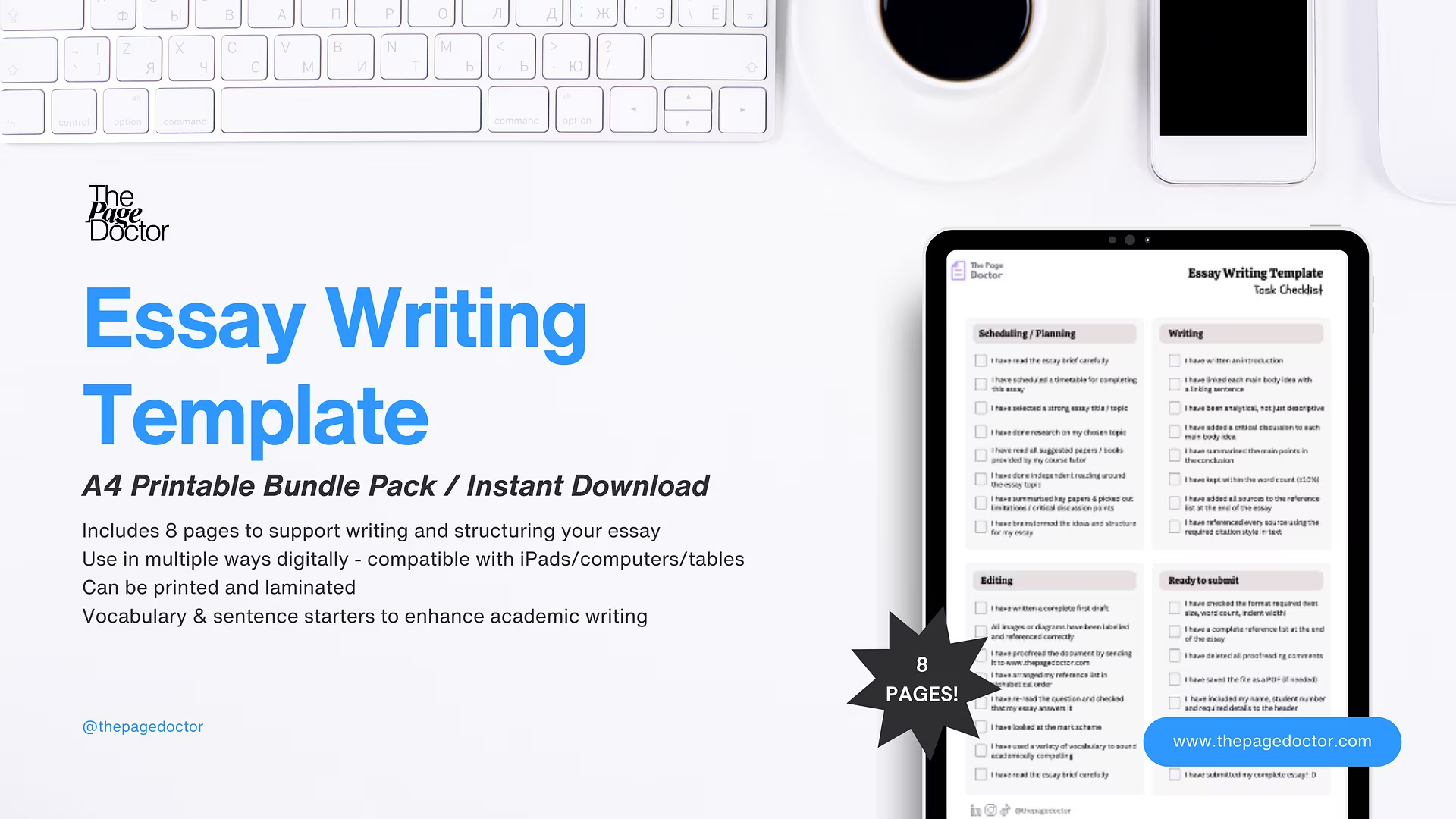
Transform your grades with our 8-page PDF bundle, designed to take the guesswork out of academic writing. Based on a decade of experience, this template guides you through every stage. From brainstorming and scheduling to final editing: ensuring your structure is rock solid and your analysis is deep. You will receive a comprehensive 1st class writing guide, a dedicated citation log, and a curated bank of academic vocabulary to instantly elevate your tone.
Book our professional editing service. Once you have written your essay, simply send it to us and we will refine it for you!
Follow us for more updates!
At The Page Doctor, we help you overcome these hurdles through:
1-1 Consultation with Dr Amina: Work with Dr Amina to identify exactly where your writing is falling short. We provide the feedback your lecturers often don't have time to give.
Proofreading & Feedback Services: Our team is composed of qualified PhD researchers and post-doctorate researchers who will meticulously review and enhance various aspects of your documents to ensure its accuracy, clarity and adherence to academic conventions.
Free Resources: Check out our founder’s YouTube channel for tutorials on everything from dissertation planning to mastering Harvard and APA referencing.
Expert-designed templates: Guides to support you through all stages of your academic journey.
