
How to Critically Analyse a Research Paper

Critical analysis is the rigorous evaluation of a research paper's quality, reliability, and academic contribution. Unlike descriptive writing, which simply summarises what an author has said, critical analysis requires you to act as an objective judge of the evidence. It involves moving beyond the what of a study to interrogate the how and why, evaluating whether the methodology is sound, if the results are biased, and how the findings impact the wider field.
At The Page Doctor, we see thousands of students who have the right ideas but lack the framework to articulate their critique. This guide will walk you through the essential steps to deconstruct a research paper and show you how to write a critique that impresses even the most fastidious markers.
The CASP Framework: A Practical Approach to Appraisal
When you are staring at a 40-page journal article, it can be overwhelming to know where to start. Here, we recommend using a simplified version of the Critical Appraisal Skills Programme (CASP) framework. This allows you to break down your evaluation into three distinct pillars:
1. Validity
Is the study technically sound? You need to look at the internal logic. Did the researchers use the right tools for the job? If they are studying a rare disease but only interviewed three people, the validity is immediately questionable.
Expert Tip: Check the methodology section meticulously. Look for triangulation in qualitative studies (using multiple sources of data) or randomisation in quantitative ones. If these are missing, the study's foundation might be shaky.
2. Results
What did they actually find? You should look for the p-values, effect sizes, or qualitative themes. More importantly, look at how those results are presented. Are the graphs scaled in a way that makes a tiny difference look massive? Is there a significant leap between the data collected and the conclusions drawn?
3. Relevance
Does this research actually matter in the real world? A study might be perfectly designed, but if it was conducted in a highly controlled lab environment that does not reflect real-world conditions, its practical relevance might be limited. Ask yourself: Can these findings be applied to my specific population or context?
To make this section more impactful, we should bridge the gap between spotting a problem and writing about it. This allows the reader to see exactly how these questions turn into high-level academic prose.
Interrogating the Text: Turning Questions into Analysis
Identifying a flaw is only half the battle; the real skill lies in explaining why that flaw undermines the research. Use these three core questions to guide your reading and transform your notes into a sophisticated critique.
1. Is the sample size sufficient and representative?
In quantitative research, a small sample size often means the results are a fluke rather than a fact. However, you should also look at who is in the sample. If a study on global stress levels only surveyed university students in London, the results lack external validity.
The Analysis Hack: Look for a power calculation. This is the mathematical process researchers use to determine the minimum number of participants needed to see a real effect. If it is missing, the study might be underpowered.
How to write it: The study’s reliance on a homogenous sample of twenty participants suggests a lack of statistical power, thereby limiting the extent to which these findings can be extrapolated to a more diverse global population.
2. Are there any hidden conflicts of interest?
Academic integrity relies on transparency. Always scroll to the end of the paper to find the Funding or Competing Interests section. If a study advocating for a specific medical device was funded by the manufacturer, the researchers may have an unconscious bias toward positive results.
The Analysis Hack: Research doesn't have to be faked to be biased. Bias often shows up in the framing. For example, ignoring negative side effects while highlighting benefits.
How to write it: While the experimental results are statistically significant, the presence of industry funding necessitates a more critical interrogation of the selective reporting observed in the discussion section.
3. Do the conclusions actually match the data?
This is the most common area where researchers overstep. They find a correlation (two things happening at once) and report it as causation (one thing causing the other). For example, just because people who drink more water are more productive doesn't mean water causes productivity. Perhaps productive people simply have better-organised routines that include staying hydrated.
The Analysis Hack: Scan the conclusion for definitive words like proves, causes, or settles. High-quality research usually uses hedging terms like suggests, indicates, or may contribute to.
How to write it: The authors conclude that Variable X is the primary driver of Outcome Y; however, the data only demonstrates a moderate correlation, leaving the possibility of confounding variables unexplored.
How to Write the Critique: Phrasing and Tone
One of the most common questions we get at The Page Doctor is:
How do I tell a world-leading professor they are wrong without sounding rude? In formal academic writing, the key is to be firm but objective. Avoid emotive language like terrible or wrong. Instead, use professional evaluative phrasing that focuses on the evidence rather than the individual.
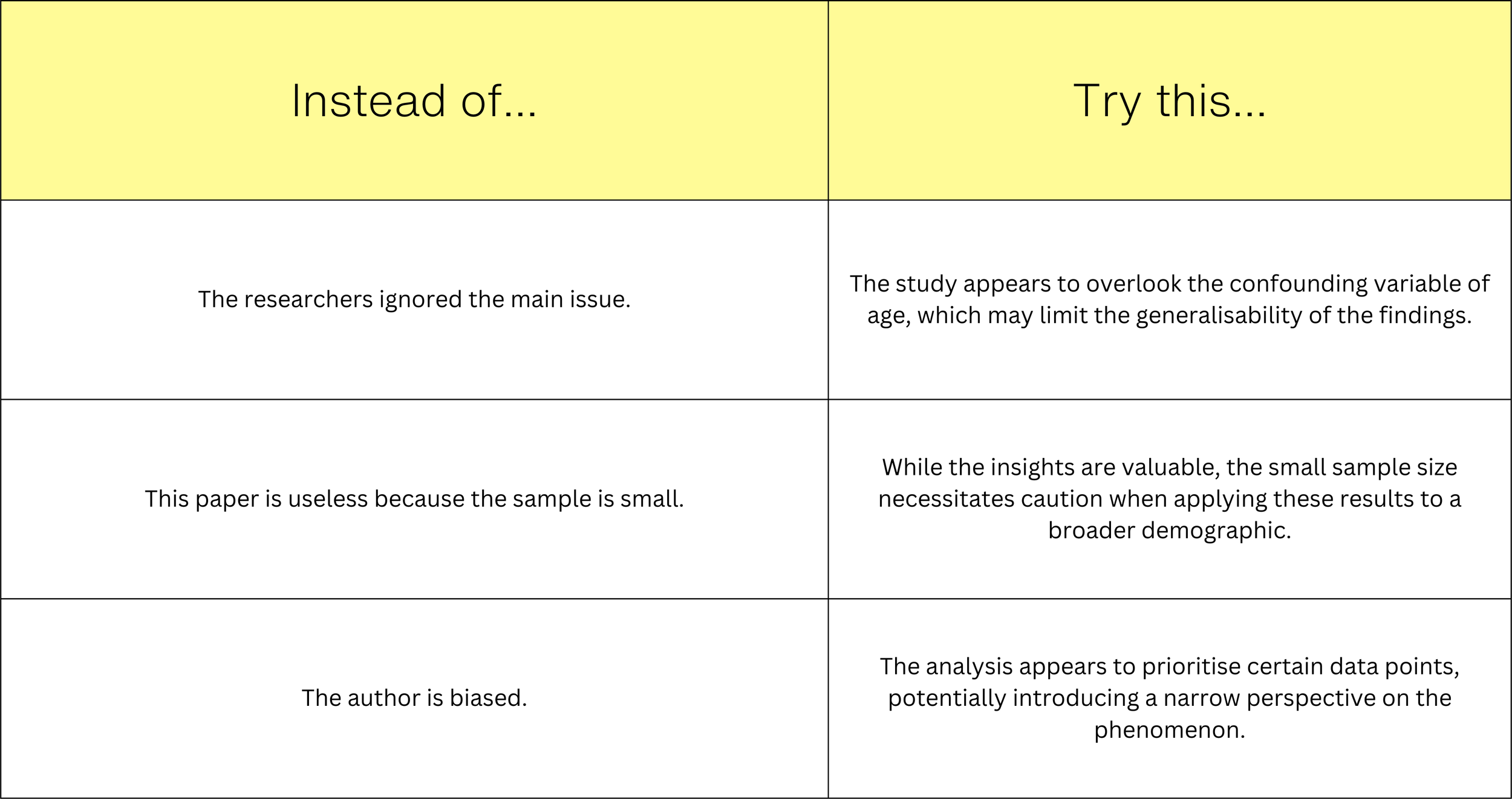
Top Tip: Use Hedging Language
By using words like necessitates, notwithstanding, or limitations, you show your marker that you are engaging with the work on a high intellectual level. It shows that you understand that academic truth is often nuanced rather than black and white.
How The Page Doctor Supports Your Academic Journey
To wrap up your paper, you must ensure that your analysis does not just exist as a list of observations, but as a cohesive, persuasive argument. Crafting this flow is often the most challenging part of the process; the strength of your critique determines whether your work is viewed as a definitive academic evaluation or a disjointed summary.
True success in critical writing lies in connectivity. You have already done the hard work of interrogating the text, and now our professional guides can provide the essential roadmap to prune away descriptive filler and replace it with a seamless narrative that dictates the direction of your paper.

By using our curated resources, you can eliminate the guesswork of balancing complex critiques with structural clarity. If you find yourself stuck at the drafting stage, you can access our research paper templates to see exactly how top-tier students frame their arguments.
Once you have finished the heavy lifting and completed your draft, do not leave your academic reputation to chance. Our team is here to ensure your analysis is not just present, but is a polished, professional anchor that commands respect and moves your academic career forward with confidence.
Follow us for more updates!
At The Page Doctor, we help you overcome these hurdles through:
1-1 Consultation with Dr Amina: Work with Dr Amina to identify exactly where your writing is falling short. We provide the feedback your lecturers often don't have time to give.
Proofreading & Feedback Services: Our team is composed of qualified PhD researchers and post-doctorate researchers who will meticulously review and enhance various aspects of your documents to ensure its accuracy, clarity and adherence to academic conventions.
Free Resources: Check out our founder’s YouTube channel for tutorials on everything from dissertation planning to mastering Harvard and APA referencing.
Expert-designed templates: Guides to support you through all stages of your academic journey.
